Tuesday, January 10, 2012

Stay Creative in 2012


Whoosh! Hear that? It's the time that's flown by since I last posted on this blog. I'm back in school for Winter term 2012. Blowing off the dust from this space, updating info and considering a new look and name soon. For today I'll just say, "hello, again!", and share with you a neat poster I discovered over here and the original is here. Since we bought our first house and my vintage business has been growing, I don't get much creative time in until I am working on assignments for school. That is unless I count photography, which I believe I will since I capture images that inspire me almost every week thanks to my iPhone and some super camera apps. All this is to say, I'm back for a bit, and I hope you're having a happy new year.

Hope you'll stop in and see what I'm up to in 2012!
Share/Bookmark

Friday, March 11, 2011

A mixture of mixed media


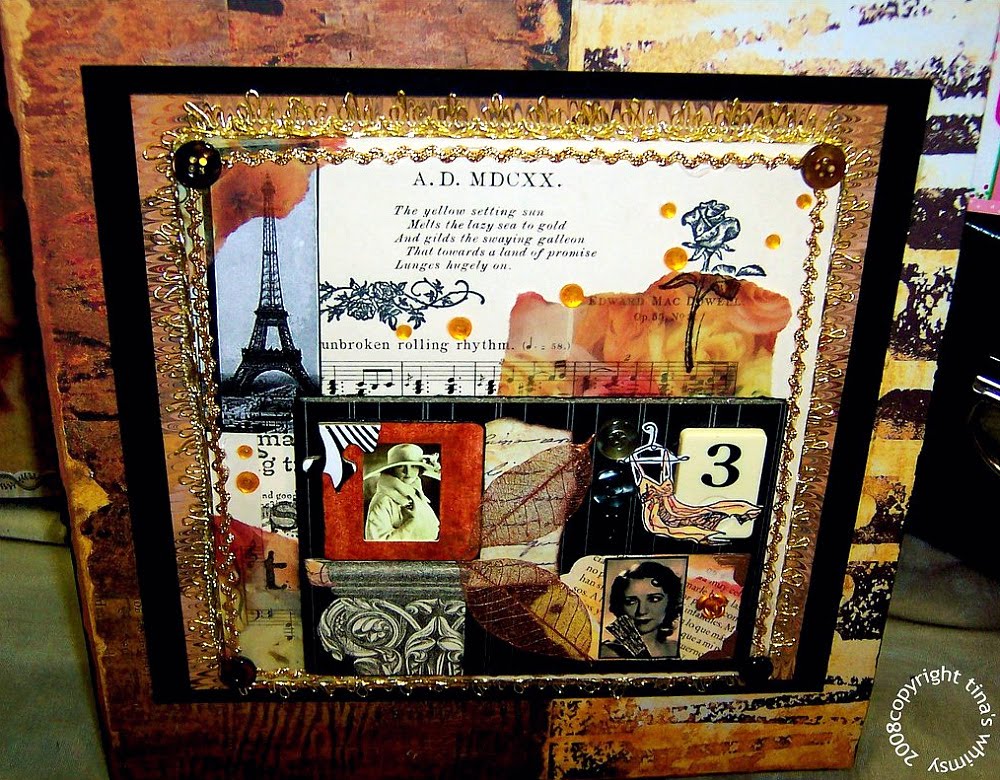
"Border Music" - Original Mixed Media Collage by Tina Pfeiffer of apt3 design


"Steps" - Altered Photography - The Altered Page


Rosehips Assemblage - Crystal Smith of Crayon Monster


Doll House Assemblage - Susanna Scott of Sushi Pot


"Circus" - Eugene Yoon (age 17!) photo source
Share/Bookmark

Wednesday, February 23, 2011

Edward Hopper's Cape Cod


All paintings from Edward Hopper's Cape Cod series--click the images for online sources. For articles and info about this series visit here, here, and here.
Share/Bookmark

Tuesday, January 25, 2011

Maxfield Parrish - Winter


Winter

Everyone knows Maxfield Parrish for his ethereal, scenic garden and sunset paintings. Most have seen a fantastic blue-rose-gold sunrise and likened it to the work of Parrish--and rightfully so.


Lull Brook in Winter


White Birches in the Snow (1952)


Village Church at Dusk (1941)

One of my illustration heroes, Parrish, although often panned by critics, is an icon in the art world. He called himself the painter of "girls on rocks" and while those are his most famous works, he was prolific in scenery and human studies (beyond girls in togas) as well.


Christmas Morning (1949)

The images in this post feature a handful of his lesser known gems.

Sources: 2, 3, 4, 5
Share/Bookmark

Friday, January 21, 2011

Animation: Walt Disney Live Reference Models


Rare film footage documenting live reference modeling of classic Walt Disney animated films. Please pause the playlist in my right margin to experience the music that accompanies this delightful collection of clips and photo stills. Best viewed in 480p--just adjust the definition slider on the lower right corner of the video window and enjoy the magic!
Share/Bookmark

Tuesday, January 18, 2011

Street Art: Miniature Architecture


photo: EVOL

EVOL is a Berlin based street artist that transforms banal urban surfaces, into miniature architectural surfaces through pasting. Using pasted paper, EVOL transforms electric boxes, small planters and other geometric city forms, into miniature apartment buildings and other structures.


photo: EVOL


photo: EVOL

Each piece of paper is printed with a repetitive pattern of flat gray walls dotted with plain window frames. once applied to a surface, the paper transforms the form into small building that EVOL often adorns with small characters.


photo: EVOL


photo: EVOL

EVOL performs this process within different cities and has even been commissioned to do installations in galleries, where he was created entire blocks of miniature buildings.

Images: EVOL, article via WebDesign.com.
Share/Bookmark

Tuesday, January 11, 2011

Block Printing


Viza Arlington of VIZArt - Fishes (4-block print - 9 x 14)

Week two of Winter term 2011 has almost ended for me. My studio art course this term is Printmaking 270 - woodblock printing. Our first project is based on the theme "Observation"--either observing or the idea of observation. Last week McClain's print supply paid a visit to our class and I purchased my supplies from their fine selection of tools and papers.

Hasui Kawase - Clearing after a Snowfall, 1944

Wood blocks have been used for printing for at least two thousand years and their earliest application was most likely as designs for textiles in China, India and Egypt. The art of wood block printing on textiles was also practiced in Europe during the early Middle Ages and reached a climax of perfection in eighteenth century France and England.


Kubo Shunman, Japanese, 1757–1820 (5 ½ x 8 3/8 in.)

One of the first forms of wood block printing done on paper (otherwise known as block book printing) was carried out by Buddhists to transcribe and disseminate the text and images of Buddhist deities. Printing with the same block of wood offered a way to mass-produce, in scroll form, the sacred words and images.

Annette Haines - Peace (Hindi stray dog, 10 x 8¼ in.)

One of the earliest known Chinese woodcuts of text and image is the 17-foot long Diamond Sutra, which was discovered in a walled-up cave in 1907 and dates from 868 A.D. The assured style and beauty of this wood block print suggests that in China wood block printing must have already undergone a long period of maturation, many centuries before western woodcuts developed.

Andy English - Monet's Gardeners (150 x 100 mm)

One of the oldest surviving records of European wood block printing is a fragment of a block depicting a Crucifixion. This block is known as the Bois Protat and is dated to 1380--500 years after the oldest known Chinese wood block print.

Tom Killion - East Pinnacles Creek, 2002

At the beginning of the fifteenth century, woodcuts were commonly used to provide cheap illustrations of religious subjects. Religious texts were also cut into the same block and the resulting prints were hand water colored. Later that century woodcuts were beginning to appear as illustrations alongside type in Germany, the Netherlands and Austria. A number of great artists such as Durer, Holbein and Cranach also created woodcuts with the assistance of professional cutters.


Kirsten Francis - Lead (8-color reductive print, 17½ x 16 in.)

During the eighteenth century boxwood blocks were used for printing with fast running printing presses. This was because the resilience of the material was ideally suited to the printing presses and the fine grain made the wood ideal for fine and detailed work. In the nineteenth century woodblocks were mainly used for cheap commercial illustrations of all kinds, and today is enjoying a resurgence of interest among visual artists and letterpress printers alike.


E. Kato - Street Scene in the Rain at Night (color woodblock print, 1930)

Woodblock printing can technically be divided into woodcut and wood engraving. The woodcut is created on the side grain of the wood while on the other hand wood engraving is worked on the end grain of the wood.


Tea & Ink Studio - Market Day (8¾ x 10½ in.)

Printing a woodcut is simple. Oil or water based ink is worked on the surface of an ink slab (which is made of Plexiglas, stone, marble or plate glass). A brayer is then used to roll up the wood block, which is usually made of gelatin. The block can also be inked with a dabber, which is a cotton pad covered with leather or silk. Soft, thin, tough paper such as rice paper, Japanese paper or other comparable European or American papers are best for woodcuts. The block is then printed by either rubbing a burnishing tool over the back of the paper as it rests on the inked block, or by printing the block on a press.


Kiran Ravilious of Inkling Prints -Linen Cushion Cover with Green Fern Motif (lino cut, 11½ x 19 in.)

Colored wood block prints can be created by either using a number of separate color blocks, which when printed together create a complete picture.

Information via. Artist and print credits are shared below each image and linked to their sites when available.

Share/Bookmark

Thursday, December 30, 2010

Cigar Box Shrines


Altered art and assemblage can take on many forms. Building an assemblage or shrine box is a creative project that combines infinite images and techniques. Like to try your hand at creating a cigar box assemblage or shrine? My Etsy shop has freshly listed vintage cigar box sets in a variety of shapes and sizes. Come by...come buy...then play!

The items featured in this post are live links - please click the images for artist info and photo sources.
Share/Bookmark

Thursday, December 2, 2010

Packing Tape Installation Art


Viennese/Croatian design collective For Use/Numen uses nothing but packing tape to create huge, self-supporting cocoons that visitors can climb inside and explore. At their last installation inside Odeon, a former stock exchange building in Vienna, the group used nearly 117,000 feet and 100 pounds of tape.

Info and images from Fast Company via Stumble Upon.
Share/Bookmark

Friday, November 19, 2010

Photography: Robert Frank


This week in Art History 206 we covered Postwar to Postmodern, 1945-1980. Each week we submit our personal response the work we have the strongest reaction to. I chose this photograph by Robert Franks. I feel this excerpt from our textbook lends the image much more depth:

"Frank used his work to reflect his concerns about alienation and lack of spirituality in twentieth-century America. Drug Store, Detroit is characteristic of his national portrait of emptiness, alienation, and despair. Under a barrage of bold advertising, some 15 men order, among other items, artificial orange whips, each patron seemingly unaware of the others. On the other side of the counter dutifully serving the white males are African-American women, undoubtedly working for a minimum wage. Just as the cake is trapped in the airless foreground case, the waitresses seem trapped behind the counter in the drudgery of the menial jobs. The glare of bare florescent bulbs bouncing off linoleum, Formica, and plastic is a reminder of the period's deadening aesthentic of efficiency and modernity, while the monotonous lineup of jukeboxes on the counter opposite the patrons underlines the "sell, sell, sell" mentality of American business. It should come as no surprise that the downtown Detroit where this photograph was taken was largely destroyed during the race riots of the late 1960s." (Janson's History of Art, 8th Ed.)

Image - Drugstore, Detroit, 1955, © Robert Frank, from The Americans
Image Source - DIA (Detroit Institute of Photography) Blog


Share/Bookmark

Tuesday, November 2, 2010

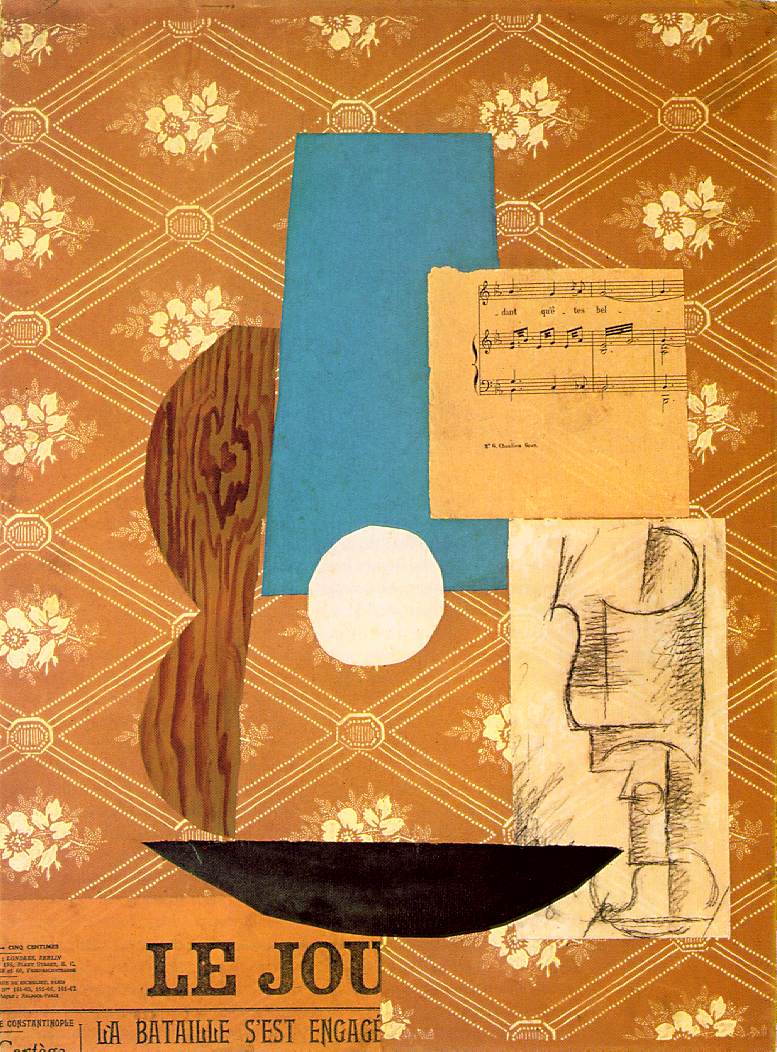
Synthetic Cubism - Picasso's Collage


A collage (From the French: coller, to glue) is a work of formal art, primarily in the visual arts, made from an assemblage of different forms, thus creating a new whole.


A collage may include newspaper clippings, ribbons, bits of colored or hand-made papers, portions of other artwork, photographs and other found objects, glued to a piece of paper or canvas. The origins of collage can be traced back hundreds of years, but this technique made a dramatic reappearance in the early 20th century as an art form of novelty.


The term collage derives from the French "coller" meaning "glue". This term was coined by both Georges Braque and Pablo Picasso in the beginning of the 20th century when collage became a distinctive part of modern art.


It was the autumn following Picasso’s return from his 1912 summer in CĂ©ret that the artist began his collage work – the pinnacle method of merging separate objects together into one. Picasso was the master of Cubism but did you know Picasso also did collage?

Images and info via and Wikipedia.
Share/Bookmark

Friday, October 22, 2010

The Robie House - Frank Lloyd Wright


Today for my Art History class, I revisited the Art Nouveau period of art, and as part of it, the architecture of Frank Lloyd Wright.

Please scroll halfway down my right margin to pause the playlist and enjoy this neat video.

For more in this series visit the Ask the Decorator series on YouTube.
Share/Bookmark

Wednesday, October 13, 2010

Faux Sunflower Seeds


"Chinese conceptual artist Ai Weiwei has filled The Tate Modern art museum's turbine hall with millions of life-sized sunflower seed husks made out of porcelain. The collective effort of a number of specialists from Jingdezhen, China, the hand-crafted seeds were individually formed and painted. The installation encourages visitors to touch and walk on the carpet of tiny replicates."
Images courtesy The Tate Modern © ai weiwei - story via Dude Craft via Design Boom.
Share/Bookmark