Wednesday, October 28, 2009

project 2: movie synopsis


I Am Here is a movie which walks in the footsteps of Dziga Vortov's, Man With A Movie Camera. In an quasi-documentary treatment, I Am Here simultaneously follows 12 hours in the lives of two young women as they encounter and interact with 21st century technology in their respective environments. The young women are college students--one attends Portland State University in the USA, the other living and studying in a rural Afghanistan village.

Both young women go about the activities of their daily lives. Tending to personal hygiene, cooking, commuting to and from school as well as work and social activities. Their cultural differences are made clear to the viewer by the multi-viewpoint perspective of the Portland woman navigating her life in a western city, while the Afghan woman traverses through a less developed and war torn plateau. Cultural differences are contrasted as the women interact with their everyday societies and engage in their respective personal norms.

This film is presented without dialogue or narration. The stories are told through use of dual images of each life followed throughout a period of 12 hours. The viewer may form their own understanding of each woman, and the universal connections between them.

Project Group: Kirk Rea, Marissa Lauer and Tina Pfeiffer
Share/Bookmark

Sunday, October 25, 2009

spirit of the times: movie posters


The Wizard of Oz (1937) - The 1930s was the era of The Great Depression. There was much to be sad about, and life in general was not so bright or optimistic. This film brought color not only to the silver screen but also to the drabness of everyday life in this decade. Oz does not bring us the most complex characters in cinematic history but this fantasy endures because of the innocence, hope and positivity of its story.


Casablanca (1942) - Set in the unoccupied African city of Morocco, during the era of World War II, again a backdrop of not the happiest of times in history. The characters are war escapees--most former idealists who have become cynical and bitter as the war progresses. The overall attitude is summed up by Bogart's character, Rick, in his "don't trust anyone" attitude towards life.


Saturday Night Fever (1977) - The 1970s fashion, dance and music time capsule movie! One synopsis I read also mentions the main characters disillusionment with lifestyle. They each want to "move up to better things" in life. In many ways this is evocative of the general atmosphere of the late 70s moving into the 80s decade--also known as the "ME" era.


The Breakfast Club (1985) -
I mentioned it in class, and had to include it here. Another classic example of an era time capsule--fashion, music and attitude. The 80s was a very self-serving decade which fits well with the time in life that we all experience--being a teen. The five main characters in The Breakfast Club just highlight the angst of the teen of their era. I was in high school at the time this movie came out and to my friends and I it seemed just about perfect.


Share/Bookmark

gallery visit: human form


Our class visit to the Cooley gallery inspired me in a quiet way. By that I mean, drawing was my first art form of choice, and still always plucks a resonant chord within me when I view work by others. The variety of the drawings in the Crocker Art Museum collection, and the span of countries and eras represented helped me to appreciate it even more.

If I had to choose one aspect that surprised me it would be the multitude of techniques, and the multiple layers of materials used in many of the pieces in the drawing collection. Chalks over graphite, layered with inks and washes--and yet they all work together in the showing as a harmonious group.

The drawing I chose to compare with a current piece(s) was in a back corner of the exhibit. The placard read: "Standing Man, black and white chalks on brown paper, German, 19th century, 1856." The Standing Man is, of course, a nude male, half draped with a sheet in the loin-cloth style. The pose is classic. Medium-well toned build. One leg slightly bent at the knee, mid-body depicted as slightly leaning against an object behind (unseen in the drawing but inferable due to the body placement), hard chin, head turned slightly, determined gaze.

One image from a more modern era immediately came into my mind to compare with Standing Man--also a classic, of the actor, James Dean (see image above). While looking up this image online, I used the search term, "standing man", and added a few alternates, each from their own decade in modern cinematic history.


Charlton Heston as Taylor in Planet of the Apes, 1968.


Harrison Ford as Dr. Walter "Henry" Indiana Jones, Jr. in Raiders of the Lost Ark, 1981.


Brad Pitt as 1st Lieutenant Aldo Raine, aka "Aldo the Apache" in Inglourious Bastards, 2009.
Share/Bookmark

Sunday, October 18, 2009

week 3: image/text hunt


This version of image with text is the "obvious" connection. The image of Sophia Loren (chosen with assistance from my husband), conveys the meaning of the sentence as the beauty of a woman as a contribution to the peril of the beholder. Damnation of a heart, of a life, of wise choices, of rational thoughts and the actions that may follow.


This pairing is my emphasis on a not-so-obvious meaning for the image with the text. After choosing Sophia for the first image pairing, Mother Teresa seemed the opposite for the choice of a beautiful woman. The beauty in this woman is seen from the inside versus the surface. Respect, admiration, love and awe are the "damnation" factor expressed by the beautiful life she lives for others. People the world over esteem her despite cultural, political or religious differences.


My final pairing approaches an unexpected context for the image with the text. The Mother Earth has beauty that has led to mans wasting, wantonness, destruction and finally the scramble to try to preserve and protect what may easily be lost forever without care.


Choice of layout, font, black and white or color images, border shapes and text placement were all considered to create the differences between each pairing.

Please click each image to view in a larger size.

The phrase:
"We were damned the minute God decided to make women beautiful."


The sentence is thought by a young man watching a beautiful woman bathe herself in a pond in the moonlight after they experience a chance liaison in the night.


From the book:
Back Roads by Tawni O'Dell, Signet/Penguin Publishers, 2000, page 173.


Share/Bookmark

Friday, October 16, 2009

bits and pieces


Images copyright Pfeiffer Photos 2008-2009 ~ all rights reserved.

Share/Bookmark

Monday, October 12, 2009

mood via color


t2b:
Run with Fire, Correfoc Festival, Spain
Sri Lankan fishermen
Chinese Turandot (dance interpretation)
Breast Cancer Awareness display, Seoul, South Korea

Images via.


Share/Bookmark

Sunday, October 11, 2009

persepolis: icons & ideology


In 1970s Iran, Marjane 'Marji' Statrapi watches events through her young eyes and her idealistic family of a long dream being fulfilled of the hated Shah's defeat in the Iranian Revolution of 1979. However as Marji grows up, she witnesses first hand how the new Iran, now ruled by Islamic fundamentalists, has become a repressive tyranny on its own. When she is ten years old, her world changes overnight. Girls and boys have to use different doors to enter the school. She has to cover herself with a long dark veil. Grownups around her began to disappear. Marjane had several close encounters with the country's morality police and her teachers at school. Iraqi bombs fell on the street where she lived. With Marji dangerously refusing to remain silent at this injustice, her parents send her abroad to Vienna to study for a better life. However, this change proves an equally difficult trial with the young woman finding herself in a different culture loaded with abrasive characters and profound disappointments that deeply trouble her. Even when she returns home, Marji finds that both she and homeland have changed too much and the young woman and her loving family must decide where she truly belongs.[1]
My observations of the use of icons to convey ideology in the film:


As mentioned in our text, the women and girls wearing traditional veils throughout the film underscores the idea "sameness" among the females in general. Iranian women, outside of Marjane's family, are shown as objects more than individuals, and are not respected by the Iranian men. An example, below, shows a mother traveling on the rear of a scooter behind her husband and three children. The Iranian men are almost all drawn with beards and many have sideburns.


Throughout the film a number of buildings blazoned with political propaganda murals with negative messages using icons symbolic of The United States. One shows the American flag behind a stylized Statue of Liberty, wearing the face of a skeleton. Another depicts the US flag with a giant skull and crossbones across its center in a sketchy graffiti-style.


The schoolgirls share images of The Bee Gees and ABBA, and, as a pre-teen, Marjane becomes enamoured with the band, Iron Maiden. These music groups were and are iconic of the late 1970s and early 1980s. Marjane also wears Adidas sneakers, an icon brand representative of America, and popular in the 80s era.


When Marjane flees to Vienna as a teen, she is befriended by a group of Austrian nihilists, all wear only black, smoke home-rolled cigarettes and their "leader" sports the iconic hair style of the 1980s punk youth--the Mohawk.


This story is semi-autobiographical, and at the same time it has been deemed as a historical piece. Persepolis was not favorably accepted by the Iranian government, and deemed to be a inappropriate due to parts which they felt misrepresented certain achievements that resulted from the Revolution.

The art of this film makes it well worth watching even for those not as interested in the religious or political themes. I watched the full version from which we viewed a clip in class--subscribers can watch instantly Online via Netflix. The dialogue is in French with English subtitles; it has been translated to English since the release to DVD.

Images - various sources, via Google search.

[1] "Persepolis." IDMB. 2009. IDMB.com. 11 Oct, 2009.


Share/Bookmark

Friday, October 9, 2009

what are you selling?


"Nations represent themselves through their currency design, using symbols, colors, textures, portraits of leaders, typefaces, decorative embellishments, mottos and phrases."

Our assignment last week was to create a new version of currency. We started with a mind-map--a kind of charting--of words and ideas for our design based on the "signs of our times". My interests do not lie in politics so I knew that was not the best option for me to use in my design. I also considered that while we are certainly a major player, The United States is not the only politically, socially or environmentally conscious country, and our concerns are not entirely shared by every other group of peoples on the planet--this despite attempts by many Americans to be the prominent influence.

That being said, my mind-map started with the word COMMUNICATION. It branched into many more words that related to that subject. I was thinking of all the ways we have and are communicating in the latter part of the last, and into the current century. Technology. Computers. Internet. Mobile telephones and devices. Electronic mail. Text messaging. Media, media, media--in newer, faster, smaller, quicker forms. It's all about connectivity, convenience, networking and instantaneous communication.

My project pared down the many ways into the prevalent methods of 21st century communication. The final product was not what I expected when I set out to create but I am pleased with the result. In viewing all the incarnations of this project as produced by everyone in the class, I was surprised to see so many similarities! Many didn't stray too far from the original United States dollar design, and/or kept a number of the original features--text, type, symbols. Overall, however, creativity abounds!

After grading, I will photograph and share my project here.


Share/Bookmark

Wednesday, October 7, 2009

reader response: chapter 2 (pg 69-89)


bri⋅co⋅lage   /ËŒbrikəˈlɑʒ, ËŒbrɪkÉ™-/[bree-kuh-lahzh, brik-uh-] –noun, plural bri⋅co⋅la⋅ges /ËŒbrikəˈlɑʒɪz, ‑ˈlɑʒ/ Show Spelled Pronunciation [bree-kuh-lah-zhiz, ‑lahzh]
1. a construction made of whatever materials are at hand; something created from a variety of available things.
2. (in literature) a piece created from diverse resources. 3. (in art) a piece of makeshift handiwork. 4. the use of multiple, diverse research methods.
The part of our reading this week that stuck with me the most was the section on bricolage. Partly because I am a collage artist, a bit because I remember the punk styles during the 1980s, and mostly because I admire the creativity and innovative quality of what our text refers to as, "the art of making do".

I decided to Google the word bricolage and see what I could find. This post contains images and explanations of a variety of associations with the word, idea and practice of bricolage. So
me touch closer than others to the definition as it pertains to our study.

Culture

In cultural studies bricolage is used to mean the processes by which people acquire objects from across social divisions to create new cultural identities. In particular, it is a feature of subcultures such as, for example, the punk movement. Here, objects that possess one meaning (or no meaning) in the dominant culture are acquired and given a new, often subversive meaning. For example, the safety pin became a form of decoration in punk culture.


Fashion

The fashion industry uses bricolage-like styles by incorporating items typically utilized for other purposes. For example, candy wrappers are woven together to produce a purse.

The movie Zoolander parodies this concept with Mugatu's Derelicte, a line of "high fashion" clothing made entirely from trash.

In reality, the current fall 2009 collection from Alexander McQueen makes use of items we would normally discard or recycle, including saran and bubble wrap, manhole covers, garbage bags and wheel hub covers.

Television

MacGyver was a tv series in which the hero is the ultimate example of a bricoleur, creating solutions for the problem at hand out of immediately available found objects.

The A-Team is another example of bricoleur. When the team found themselves in a situation which required creativity for defense or escape, they put together weapons out of any objects available.

Life itself is a bricolage of bricolages, meaning you never know what you are going to get the next day. A reminder of the quote about the box of chocolates made famous in the movie, Forrest Gump. We tend to use whatever resources are available to us in order to survive, which essentially defines the idea of bricolage.

Household Items

A paperclip is a common office item. Used to hold papers together, it can also be turned into a sculpture, a tool for carving/etching into things or even an elaborate light fixture.

Cooking and Food

Cooking is an example of bricolage in everyday life. Cooks often improvise new recipes when key ingredients are not at hand. A well known example of bricolage is the banana. Not only a source of nutrition, it can also calm stomach aches, or help to moisturize the face when made into a mask. A banana peel can be used to buff shoes, polish silverware, and promote the healing of warts, scratches, and minor cuts.

Everyday Life

The lime is a super example of bricolage. A common ingredient used for cooking and adding flavor, it's also used for cleaning. Lime juice can clean pots and pans, bathroom surfaces and glass. Many people use it as a substitute for hair gel and hair spray.

Most info via Wikipedia, images - various Internet sources.


Share/Bookmark

Saturday, October 3, 2009

photography: the lonely pixel


View more of Lisa's work
here.

Images copyright Lisa Howarth, 2009 | all rights reserved.


Share/Bookmark

Friday, October 2, 2009

photography: erin tyner


These photos are from the Half Awake series, an ongoing series featuring miniature figures.

View more of Erin's work here and on her Flickr stream.

Images © Erin Tyner, 2009 | all rights reserved.


Share/Bookmark

Thursday, October 1, 2009

reader response: representation and truth


Weegee and Emmett Till

The image by Weegee, The First Murder {of which the actual title is Their First Murder} is more powerful to me than viewing the murder victim. Note in the version I have posted that there are two people shown on the right that were cropped from the version in our book.

As we discussed in class, the Punctum is strong and the different faces and emotions within do grab my attention. That he chose to render his subject in the high contrasts of black and white lends an even stronger atmosphere to this photograph. I found it interesting that I feel more emotion when I view this photograph than the infamous shot of Emmett Till in his casket. As a side note, I was impressed with Weegee's innovative mobile darkroom in the trunk of his Chevy!

Henri-Horace Roland de la Porte: more still life works


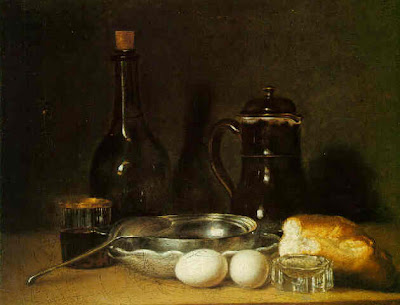
As an Art History major I've studied the works of the 17-18th century Dutch realism painters. The layers of symbolism are part of the cultural context and the artists version of "snapshots" from their period in time. Because of my former studies, the original Still Life by Henri-Horace holds as much meaning for me as the modern take-off by Marion Peck.

Robert Frank: The Americans


We spent a fair amount of time discussing the truthfulness of photography. I struggle with this kind of discussion. I understand the point that a photo can be altered both before and after it is produced but I don't look at photographs as something of solidity.


To me, a photograph is just as fleeting as the moment that is captured within it. The truth of a photograph is no different than the truth of a drawing, painting or sculpture. Each contains an element of the human who created it--whether added before or after the creation. Images are powerful. They do wield an influence but since we all filter any form of communication through our own values and experiences, I don't believe that an image can hold sway on the ultimate decisions we choose to make on any given subject.


Images from The Americans by Robert Frank.

View more info and images here.

Share/Bookmark